12 days, 11 nights
Specific Tour
16 people
___


Deosai National Park is among the prime attractions in Pakistan, offering a unique wilderness experience beyond the towering peaks of the Himalayas. Deosai National Park, known as the "Land of Giants," spans over 3,000 square kilometers and is renowned for its diverse wildlife. Visitors have the chance to spot the majestic Brown Bear, elusive Snow Leopard, and a variety of other fauna in their natural habitat.

Khunjerab National Park, located in the breathtaking Karakoram Range, is Pakistan's highest national park and boasts a rich biodiversity. Here, you can encounter iconic species such as the Marco Polo sheep, Himalayan ibex, and the elusive Snow Leopard..
Welcome to Islamabad! You will be greeted by an English-speaking assistant at the airport after immigration and custom. The assistant will escort you to your hotel. We will have ample time for sightseeing and shopping in colorful old bazaars of Rawalpindi and new markets of Islamabad. We may also drive to the modern Faisal Mosque in Islamabad. Drive: 40 minutes Activities: Cultural exploration , Sightseeing Accommodation: Hotel
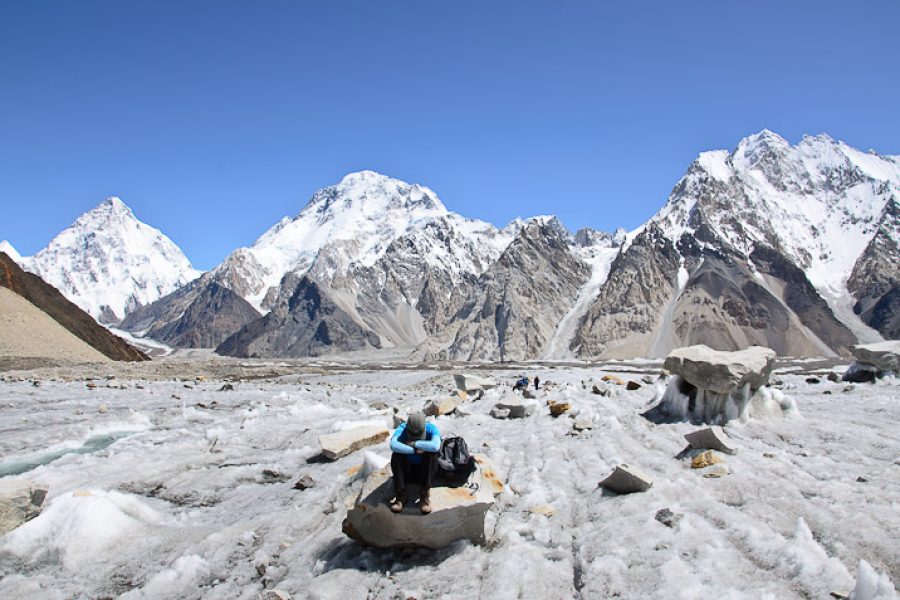
We rise early to be at the airport in time for our flight to Skardu. If the weather is good, we’ll be treated to one of the finest views available in the world of aviation, as we thread our way up the largest congregation of mountains of Karakoram, Hindukush, Himalaya and Indus River gorges, third longest in Asia and one of the deepest in the world. To our east is K2 (2nd highest in the world and Nanga Parbat (killer mountain) and countless peaks and glaciers. It is sometime possible to catch a glimpse of K2 in the distant before our dramatic landing at Skardu. On arrival we are met by our local staff with jeeps and make the short transfer to the hotel. SKARDU is the administrative capital of Baltistan and gateway to the high peaks of Northern Pakistan. We have some time to explore the town and enjoy the hustle and bustle in peak season of tourists here. Sightseeing in Skardu and surrounding areas during the day. For those seeking a good overview of Skardu, or a place from which to photograph the sunset, Kharfocho Fort is an ideal spot. If the flight is unable to operate because of bad weather, we will resort to travel by road on Karakoram Highway (KKH) to Chilas. The drive is compensated by the beautiful scenery along the Karakoram highway and Indus gorges. The journey on the Karakoram Highway is most exciting and thrilling. It is a monument to the engineering feast and one of the most spectacular roads and the world’s highest metalled border crossing. It connects Pakistan and China stretching over a distance of 1300km between Islamabad and Kashgar, winding through three mountain ranges and following the ancient Silk route along the Indus Valley to the Chinese border at Khunjerab Pass. We pass through the historical town of Taxila, beautiful hill station of Abbottabad, quake affected lush green towns of Mansehra, Shinkiari and finally meet the great Indus on Thakot Bridge. From there onward the road snails along the bank of the Indus with contrasting landscape after every two kilometers. We pass through Besham, Dassu, Komila and Shatial to arrive at Chilas with many rock carvings and inscriptions along the way left by Chinese pilgrims and ancient travelers of 5th century A.D. Chilas was on the ancient caravan trail over the Babusar Pass into India. The view after crossing the Rai kot Bridge of Nanga Parbat is without any parallel. Standing at around 1,000 m. you see a mountain which rises to above 8,000 m! This is the largest land escarpment in the world. This is also where the three greatest mountain ranges meet; Himalaya, Hindukush and Karakoram. Flight: 45 Minutes Drive: 10-12 hrs Activities: Cultural exploration , Sightseeing, Hiking,Jeep Safari Accommodation: Hotel
This day may be needed to complete the KKH road journey from Chilas to Skardu. Alternatively, leaving Skardu today will enable us to enjoy an extra day of trekking. Drive:(Chilas to Skardu) 10-12 hrs. Activities: Cultural exploration , Sightseeing, Hiking,Jeep Safari Meals provided: Breakfast Accommodation: Hotel
Today we rise early and view the beautiful sunrise against the backdrop of the Karakoram. After breakfast drive alongside the Indus River to the beautiful valley of Khaplu, which lies at the banks of Shyok river. After a small break at Khapolu we continue our four hour journey through several small villages towards Kandey, one of the highest village in Baltistan. Distance: 135 Km Drive: 07-08 hrs. Altitude: 3050 M Meals provided: Breakfast, Lunch, Dinner
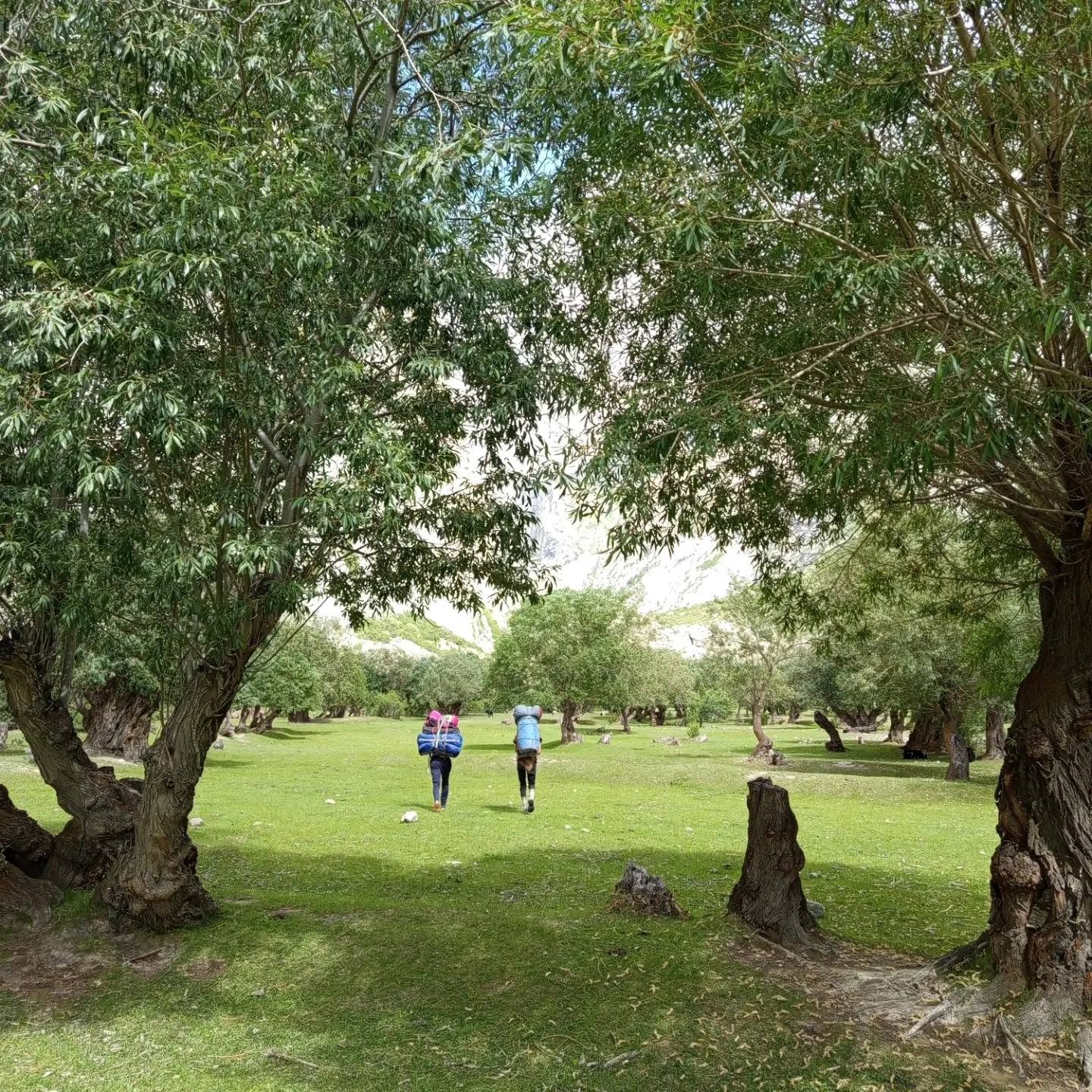
The trek begins from Kanday at roughly 2,600–2,800 metres, depending on the exact trailhead used.
From the village, the route crosses the river and gradually leaves the cultivated landscape behind.
The early trail passes through:
The mountains become progressively more dramatic as the trail moves deeper into the valley.
Several river and stream crossings form part of the route.
These crossings are one reason why a local guide is highly recommended, particularly early or late in the trekking season when snowmelt can increase water levels.
The trail then climbs toward Mingulo Broq.
Mingulo Broq is one of the most attractive places on the Nangma route.
Located at approximately 3,500 metres, the broad alpine meadow provides a dramatic contrast to the lower valley.
During the summer season, the area can be green and covered with wildflowers while livestock graze nearby.
Trekkers may encounter:
Mingulo Broq is also an important acclimatization point.
Rather than rushing directly from Kanday to the highest camp, spending the night around 3,500 metres allows the body to adjust before moving higher.
Mingulo Broq — approximately 3,500 m
he second day enters the spectacular heart of Nangma.
The trail continues upward from Mingulo Broq toward the upper valley.
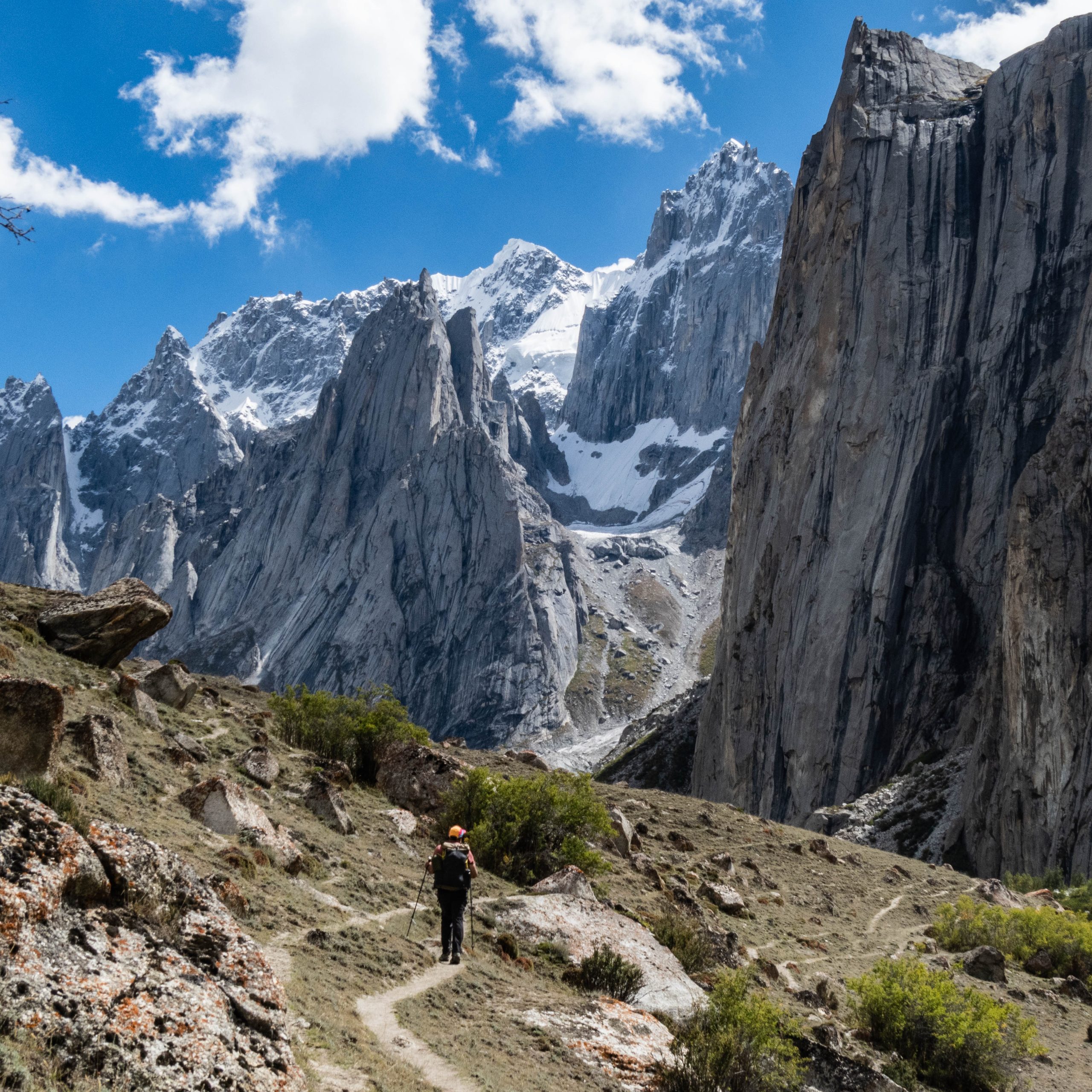
The landscape gradually changes from open pasture to increasingly rugged alpine terrain.
Granite walls become larger.
Glaciers become more visible.
The valley narrows.
The mountains begin to dominate the entire horizon.
Eventually, trekkers arrive at the main upper Nangma camping area at approximately 3,950 metres.
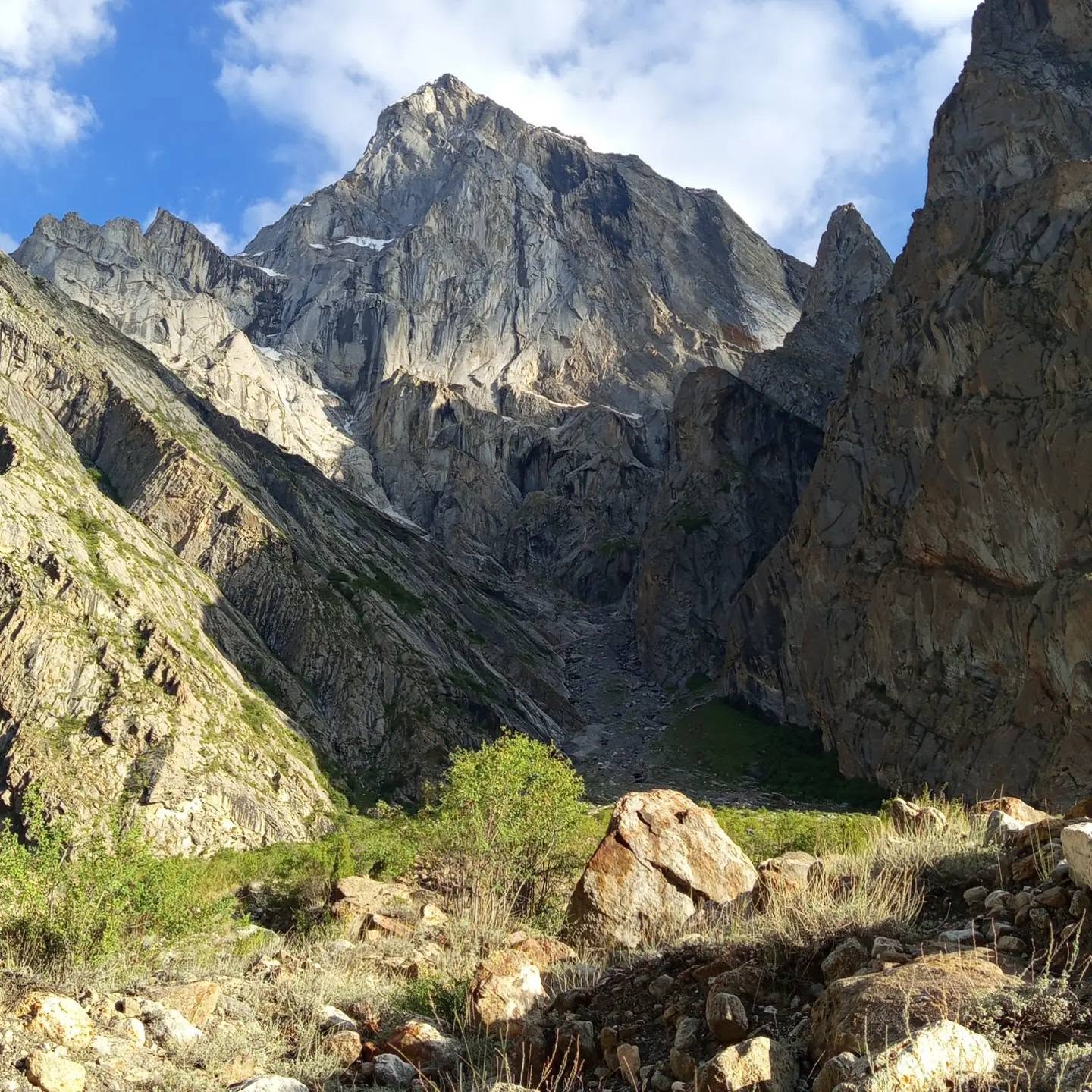
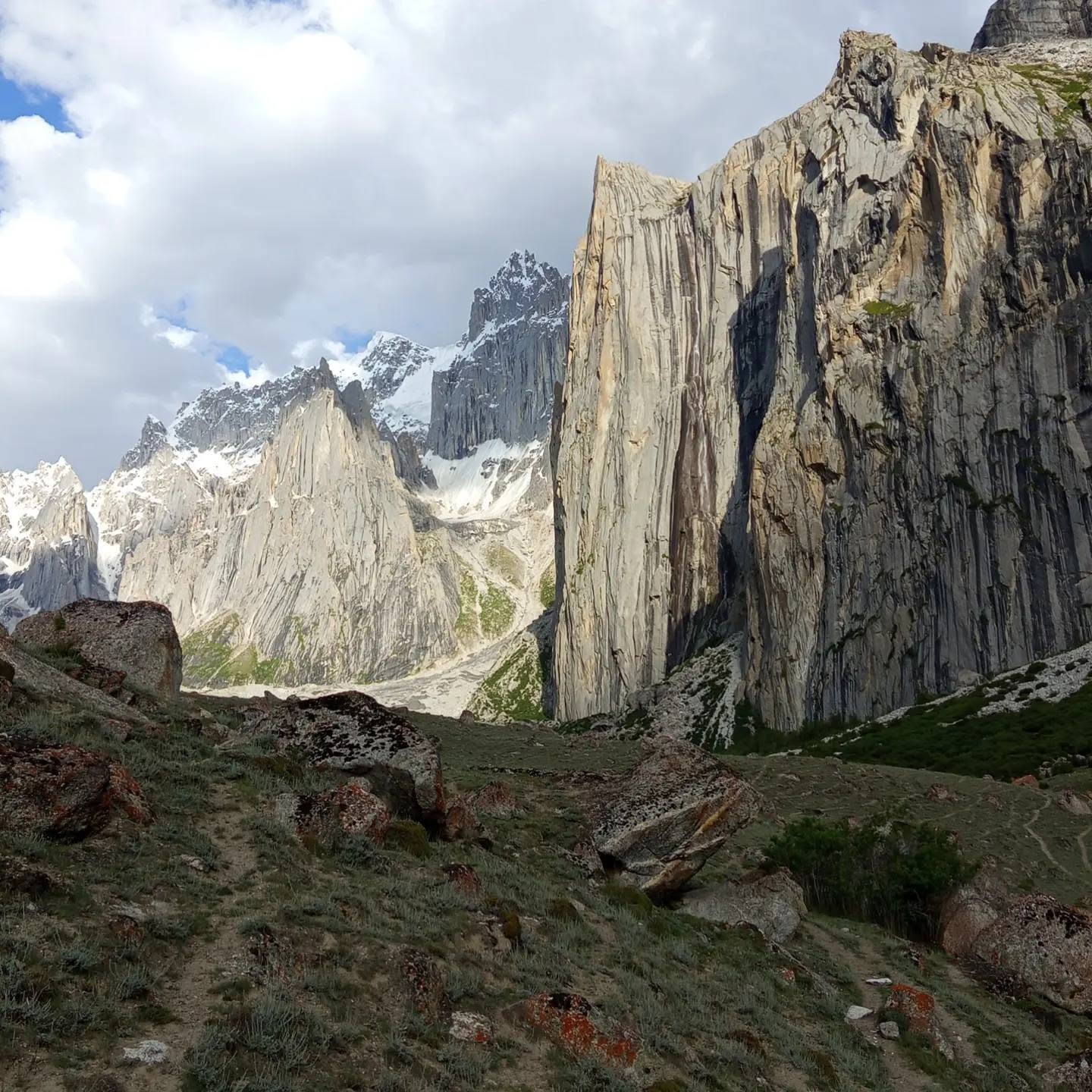
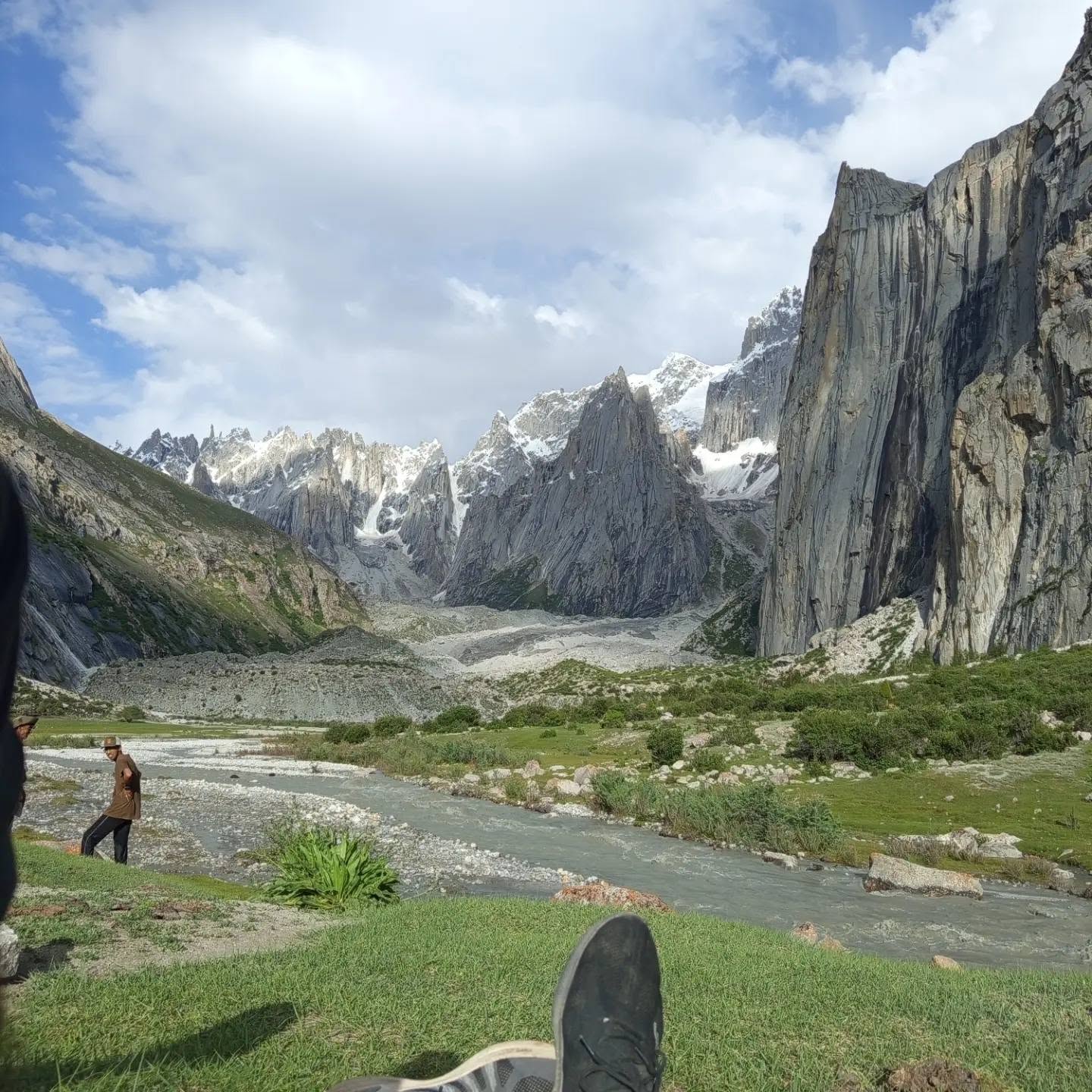
The upper Nangma meadow is the visual highlight of the standard trek.
At around 3,950 metres, the campsite sits inside a dramatic mountain amphitheatre.
Huge granite walls surround the valley while glaciers and snow-covered peaks rise above them.
This is the point where the famous “Yosemite of Pakistan” comparison becomes understandable.
But the environment is far more alpine than Yosemite.
The camp is surrounded by:
There are basic stone structures in parts of the valley that may be used by local shepherds and trekking crews, but travelers should plan for full camping rather than relying on permanent accommodation.
Upper Nangma Valley — approximately 3,950 m
One of the major attractions of the Nangma trek is the opportunity to walk higher toward a viewpoint overlooking K6.
The standard excursion is a day hike from the upper Nangma camp.
Trekkers leave the main camp with a light daypack rather than carrying full camping equipment.
The route climbs through increasingly rocky terrain and follows the upper valley toward the glacier and mountain viewpoints.
The commonly described high point is approximately 4,300 metres.
From here, weather permitting, trekkers can obtain dramatic views toward K6 and the surrounding peaks and glaciers.
The round-trip excursion can take several hours depending on route conditions, weather, group pace and how far the local guide considers it safe to proceed.
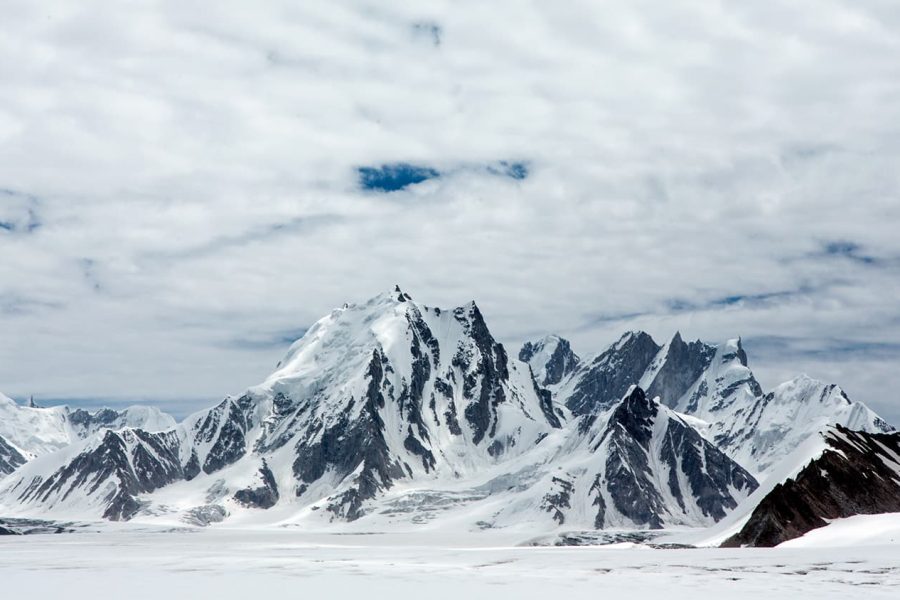
K6, also known as Baltistan Peak, is one of the great mountains of the Masherbrum range.
Its elevation is approximately 7,282 metres.
The mountain is characterized by enormous relief, steep faces, glaciers and highly technical climbing terrain.
K6 is not a trekking summit.
Seeing K6 from the Nangma region is a completely different experience from attempting to climb it.
The mountain's technical nature has attracted serious mountaineers for decades.
Nangma is not simply a viewpoint for K6.
The valley is directly connected to the history of the mountain's first ascent.
In 1970, an Austrian Karakoram expedition led by Eduard Koblmüller approached K6 through the Nangmah Valley.
After reaching Kanday, the expedition crossed into the Nangmah Valley and established Base Camp at approximately 4,300 metres beside the Nangmah Glacier.
The expedition eventually made the first ascent of K6 via the Southeast Ridge.
This gives Nangma an unusual mountaineering heritage: the same valley visited today by trekkers was part of the historic approach to the first ascent of a 7,000-metre Karakoram peak.
This distinction is important for travelers.
The K6 viewpoint commonly visited on the Nangma Valley trek is not necessarily the same thing as an expedition's K6 Base Camp.
subject to path, trekkers fitness we may have a visit to base camp as well but standard trek ends here.
The historical K6 expedition established Base Camp at the edge of the Nangmah Glacier, at approximately 4,300 metres.
Depending on the season, glacier conditions, local route and expedition objective, reaching the actual historical or modern K6 base-camp area may involve significantly more demanding terrain than the standard tourist trek.
It can involve:
Exploration of K6 Base Camp / Nangmah Glacier area
After the K6 viewpoint excursion, trekkers return to the upper Nangma camp.
Depending on the itinerary, the descent can begin the following morning.
The return to Kanday is considerably faster than the ascent for most trekkers.
The trail descends through the upper valley toward Mingulo Broq and then continues down to Kanday.
The landscape looks completely different in the opposite direction.
From the upper granite amphitheatre, the route gradually returns to:
Eventually, the mountains open and Kanday comes back into view.
A jeep journey along narrow mountain roads passing small farming settlements leads first to Khapulo and then to Skardu (6-7hrs). Drive: Distance: 130 Km, Ascent: 100 m, Descent: 600 m Time: 06-07 hrs,
De-briefing at Ministry of Tourism Skardu. Late morning fly to Islamabad,. With clear skies we will be able to board a plane and be back at our hotel in Islamabad in 45 minutes. If the weather is not so favorable and the flight doesn’t come, then we will have to drive the Karakoram Highway to Rawalpindi through the narrow gorge of the Indus River . The outcome is in the lap of the Gods, so we will be praying that they’re on our side! If we are able to fly down, for those who want to escape the heat of the city a very pleasant excursion is up to the former British hill station at Murree. The faded remnants of the town’s colonial past can be seen in its gable-roofed buildings and small Anglican churchyard. This excursion is not included in the trip price but if any member of the group wish to make this journey a private vehicle and driver can be hired locally for a very modest sum. Back in Rawalpindi we enjoy a final evening meal usually taken at one of traditional food streets either in Islamabad or in Rawalpindi. Activities: Jeep Safari or Air Safari Meals provided: Breakfast Accommodation: Hotel
Upon arrival transfer to your hotel in Rawalpindi. Evening sightseeing. If unable to fly on day 18th, this day will be use to transfer from Chilas to Islamabad by road. Activities: Jeep Safari, Sightseeing Meals provided: Breakfast Accommodation: Hotel
Transfer to Airport for onward flight Activities: None Meals provided: Breakfast Accommodation: None
The most practical gateway for the Nangma Valley trek is Skardu.
Travelers can fly from Islamabad to Skardu when flights are operating and weather permits.
The flight is short compared with the overland alternative, but mountain weather can cause delays or cancellations.
Travelers should always keep a buffer day in their itinerary.
The overland journey follows the Karakoram region toward Skardu.
Road travel takes considerably longer but provides an opportunity to experience the mountain landscape.
For international trekking groups, VEPakistan should generally build contingency time into the itinerary rather than scheduling a same-day international connection after the Skardu leg.
From Skardu, the route continues toward Khaplu and then into the Hushe Valley.
The road journey takes travelers through one of the most spectacular parts of Baltistan.
Khaplu is an excellent stopover because it offers:
From the Khaplu side, travelers continue by suitable local transport toward Kanday.
The final road section is mountainous and conditions can vary.
A local 4x4/jeep and experienced driver are strongly recommended.
Yes, fit beginners with reasonable hiking experience can undertake the standard Nangma trek with proper support and acclimatization.
The important distinction is between:
Nangma Valley Trek — suitable for fit hikers
and
K6/Nangmah Glacier Base Camp Extension — suitable for experienced trekkers with appropriate support and conditions.
Yes, it is always advisable that in any trek carry your own personal medication and basic first aid kit with you. No need to worry!
Nangma is ideal for:
Travelers who want something beyond conventional Pakistan sightseeing.
Especially landscape and astrophotographers.
Fit hikers looking for a relatively compact high-altitude trek.
Travelers who want to experience the Karakoram without attempting a major peak.
People interested in seeing the famous granite walls.
Especially travelers who have already experienced Hunza, Skardu and the more established tourist routes.
Those looking for a less crowded alternative to Nepal's famous trekking routes.
Our trek leaders are expert in first-aid and are aware of high attitude problems. We carry complete first-aid kit, oxygen cylinders, improvised stretchers,necessary medicines (relating to AMS) and extra team members with us may it be any contingency.
Glacier water is naturally clean but for safe side we use boiled water and chlorine tablets in our camps, it is requested by all the participants to consult our outdoor team before filling up there water bottles during the trek. Hot water is made available for drinking while on the trek. Travelers should also carry chlorine tablets with them.
Yes, if you have a small bag of extra clothing for when you return from the trek, you will be able to store it safely in Islamabad or Skardu for the duration of the trek.
All of the meals served on Our trips are a combination of the best local and regional fares along with some specialty items. Lentils and rice is a common local dish. There will be a variety of hot and cold options for breakfast (porridge, cereal, eggs and bread). Dinners are a mix of pastas and dumplings, chicken, a variety of vegetables, soups and rice dishes. Lunches are often picnic style and various items for and fruit as well as hot tea are provided. Our cook staff is very accommodating to various dietary needs. Let us know before your trip of any dietary restrictions and we will be happy to accommodate your needs.
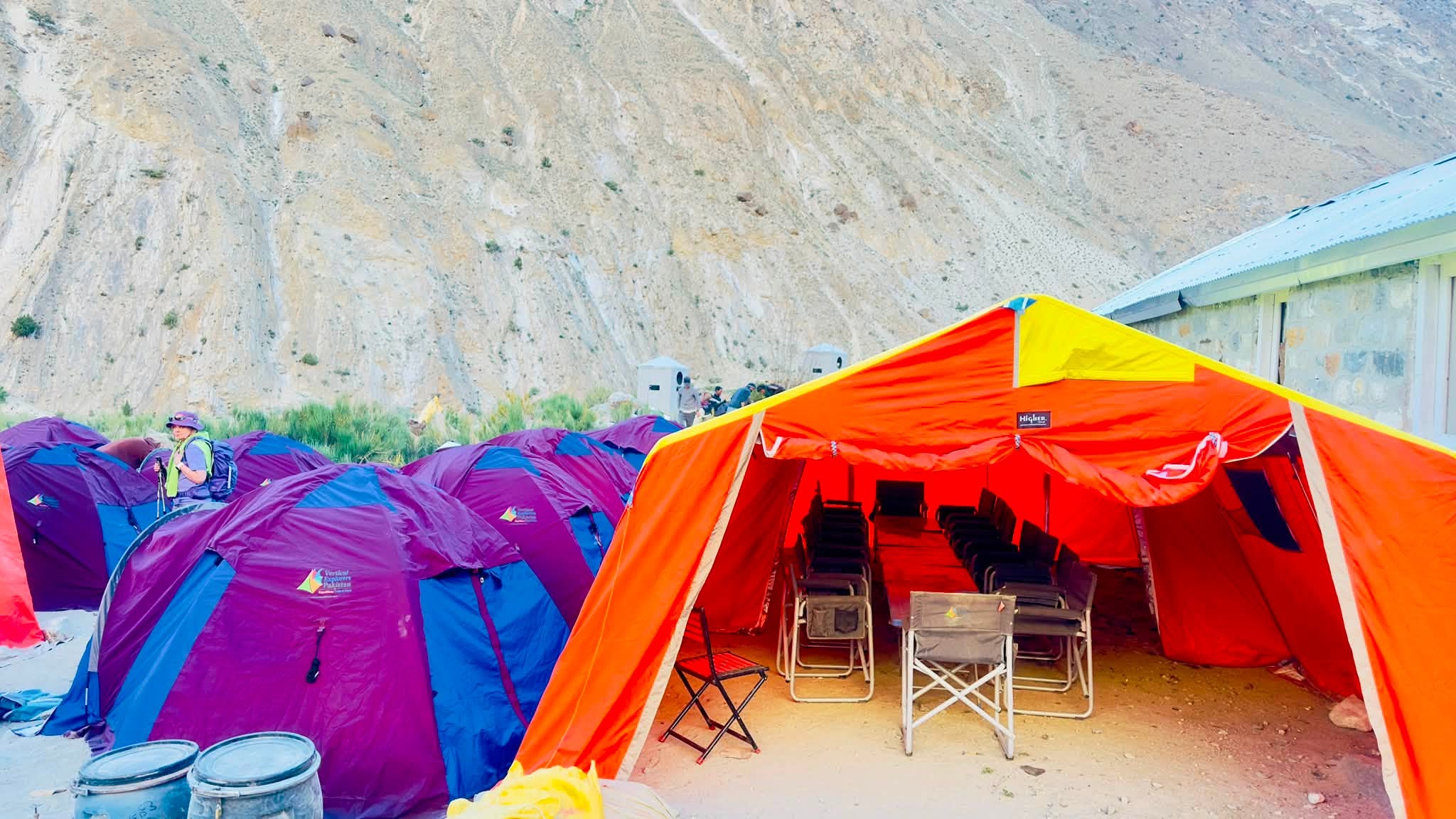
We have three men tents but two people will be accommodating in one tent. Also it maintains the temperature required to have a warm and comfortable sleep in the night
Yes, our first priority is to create a safe environment for all the trekkers, and a girls’safety is the foremost important thing for us. At the time of Rooms/Tents allotment the boys and girls are segregated in different accommodations. We always create a friendly environment between trekker's and other supporting staffs are carefully chosen for your trips keeping all safety measures in mind. But we would also advise you to take care of your own personal belongings.
Trekking shoes is one of the most important things needed in any trek, so you have to be very careful before buying it. Recommended only high-ankle and waterproof shoes which are branded and are specifically designed for trekking purposes.Quechua, Zamberlan, Lafuma, Conquest and The North Face are some high quality brands dealing in High Altitude trekking shoes
What do i need to bring? A complete clothing and equipment list specific to your trip will be sent to you in a dossier. Every year, after assessing feedback from our clients and guides, we review and update our lists so they are as complete and up-to-date as possible. Every list has a description of each item, however feel free to call us if you have questions or need help locating any of the items on the list. It is extremely important that you adhere strictly to the equipment list.
Typically, we don’t have equipment checks for international trips until you are in-country, and you can’t always count on finding an outdoor supplier in Skardu during the days just before a trip begins that has what you need. Therefore, it’s extremely important you follow the equipment list guidelines and bring every item on the list. If you have any questions concerning any of the items mentioned in the equipment list, please contact us.
We may be able to procure some items in Skardu. Call us for specific information regarding your trip.
Your K2 Base Camp Trek will be a fully supported trek with porters and pack animals. You will be carrying a daypack on trekking days, which would contain snacks, camera, water and extra clothing.
All accommodations are based on double or triple occupancy. If you are traveling solo and wish to share accommodations, we will pair you with another traveler of same gender. Singles are available in Skardu. If you request single accommodations or a roommate cannot be assigned, you will be responsible for paying the single supplement fee.
The standard Nangma Valley Trek is generally considered moderate.
The main route does not require technical climbing or glacier travel.
However, it should not be marketed as an easy sightseeing walk.
The principal challenges are:
The upper camp is around 3,950 metres, and the K6 viewpoint is around 4,300 metres.
For a healthy and properly acclimatized trekker, these elevations are manageable, but altitude should always be taken seriously.
We loves to customize personal trips -- for you, your friends, or organization. Our published land costs are typically based on number of individuals, so the number in your party may affect your land costs. Just give us a call/contact us and let us know what you're interested in, and we'll do our best to Make It Happen.
We are happy to help you arrange accommodations before and after your trip. Our area directors can recommend side excursions and restaurants for the extra time.
Our guide or representative will pick you up at the airport on the scheduled arrival date. We can help you arrange accommodations if you arrive earlier, and we are happy to make suggestions for transportation, restaurants and sightseeing.
All of our guides are highly skilled experienced professionals who have been selected based on their careful judgment, local knowledge, understanding of our client's needs, patience and supportive guiding styles, and great personalities. In addition to their impressive personal achievements in the field, our guides bring a wealth of natural history, cultural anthropology and linguistic knowledge for their group's enlightenment. Our international guides and staff surpass the needs of our clientele and make the trip enjoyable beyond expectations.
During a trek, if someone becomes ill or feels that they do not wish to go any farther, the guides decide whether the person requires an escort for descent (by a local staff or assistant guide) or if he or she can stay put until the group returns.
Tipping is always a personal choice, but is greatly appreciated by your guides. Check your departure packet for details.
Absolutely! Our recognizes our trips as physical, scenic, and cultural odysseys into these landlocked regions, and so we encourage you to interact with the locals. Our guides are experienced in the proper cultural courtesies and will be able to advise you along the way regarding these considerations.
There is no way to know how quickly our trips are going to fill up. Many of our trips fill up months in advance. So send in your application and a deposit as soon as you have decided which trip date you want.
You can sign up for the trip directly on our website. To secure your place on this trip, please click on the BOOK NOW button at the side of the page, or the dates tab to the right. You will also need to have the below information to hand: • Name as per Passport • Home Address • Email Address • Telephone Number • Date of Birth Before you embark on your trip, it is essential that we receive your passport, travel insurance, next of kin, medical details and dietary requirements (if applicable). If you have any medical conditions to declare or are over the age of 65, you will be required to complete a medical declaration form, signed and stamped by your GP. If you don’t have all this information to hand, you can still register your place today, and then re-log into the form before you depart by using your email address and the password you create upon registration.
US$300 for scheduled trips. An application alone won’t reserve a space.
If we cancels a trip due to any reason, you will receive a full refund.
We highly recommends the purchasing of trip cancellation, travel insurance and medical evacuation policies. Once we have received your application and have confirmed your spot on a trip, we will send you information about the various types of insurance and insurance companies we would recommend.
K2 Base Camp is one of the world's most famous trekking destinations.
Nangma is different.
For travelers with limited time, Nangma can deliver an extraordinary Karakoram experience in only a few trekking days.
Being in good cardiovascular shape is the key. We encourage you to walk steps and stairs each day as the best conditioning before you depart. If you work out at a gym, focus on the StairMaster although walking actual stairways is probably more effective for your overall training. For those of you who are already in great shape – trail runners, marathoners and triathletes – you should know that while you’re in great shape physically, you won’t have much advantage to those in your group who aren’t when it comes to acclimatization. You won’t be able to ascend any faster than the group. Whatever your level of fitness, you should adopt the mantra: Trekking is about the journey not the destination… and remember that we take it slowly to properly acclimatize. Read more about How to get fit for a trek?
A normal day starts with your guide knocking at your door at around 6:00 am in the morning. The breakfast served in the dining tent is usually at 7:00 am allowing you enough time to wash up and pack up. The trek normally begins at 8:00 am. You will be accompanied by your guide and a porter. In average, 3-4 hours of walking is covered before lunch. Lunch will be at a tent en-route. After lunch, normally 3 more hours are covered before reaching the destination of the day. Dinner in the dinning tent is around 7:00 pm before retiring for the night.Acclimatization days are built in along the way where we stay at the same place for an extra night. During this day, you are welcome to explore side hikes.
We have taken trekkers ranging in age from 18 to 78 as high as Gondogoro La (5585m). Our trekking groups are limited to a maximum of 12 members to guarantee quality and personalized service. Small group travel fosters intimacy with the local cultures and the land and ensures quality for each trip member. Our guests come from a remarkable cross-section, ranging from full-time students to physicians, business executives, computer programmers, stay-at-home moms (and dads), writers, etc. In addition, your trekking entourage includes a staff which will number approximately 1:6 . Along the way, your trekking staff will introduce you to their family and friends putting you on a first name basis with tea shop owners, traders, porters, farmers, schoolteachers, and curious children.
Nangma is a remote mountain environment rather than a conventional tourist attraction.
The main safety concerns are therefore environmental:
A local guide is strongly recommended even when a particular route does not legally require one.
A guide knows:
Altitude is one of the most important considerations.
The trek climbs from roughly 2,600–2,800 metres at Kanday to around 3,500 metres at Mingulo Broq and approximately 3,950 metres in upper Nangma.
The optional high viewpoint reaches approximately 4,300 metres.
Travelers should:
No itinerary should treat altitude sickness casually.
es, depending on the traveler's schedule and route.
Nangma is on the Hushe side of Baltistan, which is also associated with the Gondogoro La route connecting the Hushe side with the Baltoro region.
A customized itinerary can potentially combine:
Skardu → Khaplu → Nangma → Hushe → Gondogoro La → Concordia → K2 Base Camp
or arrange Nangma as a shorter separate trek before another Karakoram expedition.
The exact sequence depends on permits, route conditions, weather, acclimatization and the trekking season.
The broader trekking window can extend from May into October, but conditions change significantly during these months.
May is a shoulder-season month.
The lower Hushe Valley may already be green and attractive, but snow can remain at higher elevations.
The upper Nangma Valley may not yet be consistently accessible.
Best for: experienced trekkers, photographers and early-season travelers.
June generally marks the transition into the main trekking season.
Snow begins retreating from the higher meadows and summer grazing activity starts.
Early June can still bring:
Late June is generally more favorable than early June.
July is one of the best months for the Nangma Valley trek.
The meadows are generally green and the landscape can be covered with alpine flowers.
Mountain views can be spectacular, although afternoon clouds and rain remain possible.
Best for: trekking, photography, camping and classic Nangma scenery.
August is another excellent month.
It is particularly attractive for travelers interested in seeing the valley during its main summer season.
Climbing activity can also add an interesting mountaineering atmosphere.
Best for: trekking, climbing, photography and adventure travel.
September is one of VEPakistan's strongest recommendations for experienced travelers.
Temperatures are cooler, crowds may be lower and clear autumn air can produce exceptional mountain visibility.
Nights are cold, however, and the season begins to move toward winter.
Best for: photographers, experienced trekkers and travelers seeking solitude.
October should be treated as a late-season/shoulder-season trekking month.
Early October may offer good conditions in some years, but higher sections can experience increasing cold and snowfall.
The upper Nangma Valley may become inaccessible later in the month.
Travelers planning October departures should have:
Best for: experienced trekkers seeking solitude and autumn landscapes.
Winter is not the normal trekking season for Nangma Valley.
Snow accumulation and freezing temperatures make the upper valley unsuitable for conventional trekking.
Specialized winter mountaineering is a different proposition and requires appropriate expertise, equipment and support.
| Month | Trekking Conditions | Recommendation |
|---|---|---|
| May | Snow possible at higher elevations | Experienced trekkers only |
| June | Improving; early-season snow possible | Good from late June |
| July | Green meadows, prime summer season | Excellent |
| August | Prime trekking/climbing season | Excellent |
| September | Cooler, clearer, quieter | Excellent |
| October | Late season, snow risk increasing | Experienced trekkers |
| November–April | Winter | Not recommended for standard trekking |
July, August and September
June and September
Late May and early October, subject to actual conditions.
The incidence of personal violent crime is certainly almost none despite sensational headlines and occasional saber rattling. The Karakorum region is known for centuries of peaceful coexistence. The incidence of personal violent crime is certainly almost none than in anywhere in the world despite sensational headlines and occasional saber rattling. The Karakorum region is known for centuries of peaceful coexistence. we have continued to operate trips in the region each year and we are confident that these regions remains one of the most beautiful, compelling and welcoming places on earth. The major concentrations of troubles are in the western parts of Pakistan and 100s of miles to the Islamabad. Their major concentrations are in areas which have had little or no tourism (investment, hard currency, etc) which is one of the reasons that their message has played well in these very poor districts. By comparison, the K2 Region is a very well and worldly part of Pakistan. That said, whenever you travel in Pakistan (or anywhere in the world for that matter), you should definitely use personal caution. We avoid any known dangerous situations. We monitor political situations posted by the government Office and ground reports from our staff and network of contacts. As when traveling in any region, make sure to keep an eye on your possessions and take certain common-sense measures to prevent theft or dangerous situations. The first rule of trekking K2 Base Camp is to step to the wall side when you meet a mule, since otherwise you can be knocked off the edge. The main danger for most people doing the straight-in, straight-out route is altitude sickness(AKA Acute Mountain Sickness or AMS). For most people, this can be avoided by sleeping no more than 300 metres higher than you did the night before and taking an acclimatisation day every 1000 metres. Serious AMS is more common in folk doing group tours than in independent trekkers. Other common injuries are twisted ankles and sprains. Rock falls, moraine and glacier crossings add significant risk to longer treks involving crossing high passes such as the Gondogoro-La. As always, it’s unwise to trek solo in case you fall and can’t extricate yourself: Do note, that it is illegal to trek solo.
Most people report that they have some mild symptoms of Mountain Sickness ranging from headache to sleep apnea to loss of appetite above 12-14,000 feet. While these symptoms are not of great concern, they are monitored closely by the Expedition Manager and staff. If symptoms become more serious, there are two options: Descend to a lower elevation – possibly resuming the trek once symptoms subside. or airlift.
For snacks, we recommend chocolate, chocolate bars, dried fruit bars and dried fruit which are readily available in Skardu, but Cliff bars, Power bars and the like are not usually available.
Sleeping bags can be hired at US$ 3.50 per day basis. However, in terms of hygiene, we recommend the guests to bring their own sleeping bags. Trekking poles can be hired in Skardu, but the cost will be the same as that of buying a new one.
Trekkers need to have traveling insurance which covers the comprehensive expenses that might incur due to medical issues or accidents. This includes air ambulance, helicopter rescue, and medical treatment costs. In worst cases, we can evacuate / rescue you via helicopter, but this can be very expensive without travel insurance.
There is no specific age of USD bills, however, we recommend the guests to carry new crisp bills when traveling. All denominations are acceptable, however, it is easier if you have smaller denominations of 5’s, 10’s and 20’s.
Pakistani tap water is not safe to drink. Bring water purifying tablets or a water purifying stickto save money and the environment. Note that at higher elevations during the coldest times of year the water will freeze, so you’ll need to use boiled water.Buy a decent thermos flask or plastic water container, so that you can top up with hot, boiled water at the beginning of the day – starting with hot water will stop it freezing.
Check the terms and conditions of your travel insurance very carefully before embarking on the K2 Base Camp trek – the elevations involved are above 5000m, and many companies simply will not cover you at that level. World Nomads offers cover for trekking up to 6000m on recognised routes like K2 Base Camp and the gondogoro and hispar Passes. You should also ensure you are covered for helicopter evacuation from the mountains in emergencies, while mountaineers should arrange cover with their specialist mountaineering association at home before they travel.
Yes – why not stay on and explore more of what Pakistan has to offer! We can request with to change your return date with the airline. Places are limited and all arrangements are subject to availability.
Our unique style of off the beaten track, face-to-face travel is the only way to really experience a destination, but it also serves to keep the costs down. We spend your money providing an authentic experience, instead of on lavish hotels and expensive western-style meals. We pass these savings on to you with our low prices. Another thing you'll notice are the inclusions. While we don't include everything, we do throw in the major highlights of a destination, the things that everyone goes to see. On every trip page we show you the 'Included Highlights' of your trip, things that many other companies charge locally for. We leave many other activities as options, to provide you the freedom and flexibility to choose what you want to do on a daily basis.


Member Since 2019